FW
Tariff increase on Chinese imports to escalate prices, hinder growth
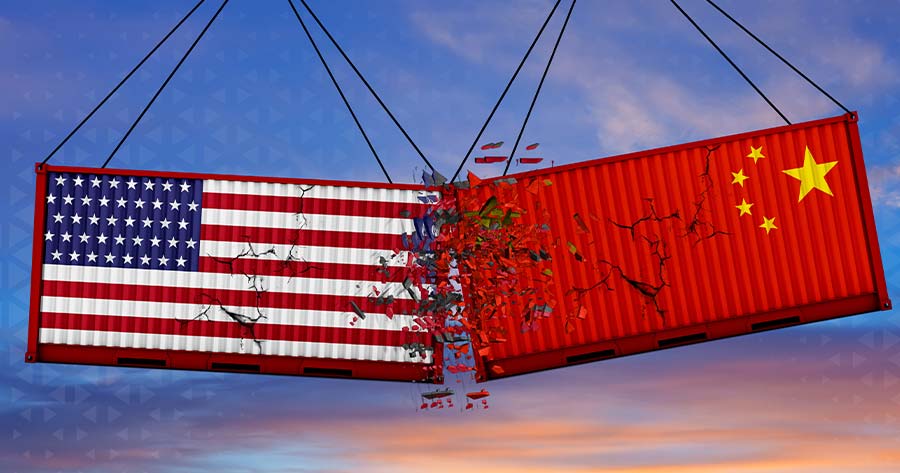
"The apparel industry is waiting with bated breath for the much-anticipated meeting between President Trump and Chinese President Xi Jinping that will decide the future of US tariffs on Chinese exports. Trump is expected to slap tariffs on another $267 billion worth of Chinese goods, which also includes apparel and footwear. This would push up tariffs from 10 to 25 per cent in January 2019. China already faces $50 billion worth of tariffs."
 The apparel industry is waiting with bated breath for the much-anticipated meeting between President Trump and Chinese President Xi Jinping that will decide the future of US tariffs on Chinese exports. Trump is expected to slap tariffs on another $267 billion worth of Chinese goods, which also includes apparel and footwear. This would push up tariffs from 10 to 25 per cent in January 2019. China already faces $50 billion worth of tariffs.
Escalating tariffs to reverse economic progress
Currently, goods originating in China, including some apparel products and leather, nearly all raw materials used to make textiles, from cotton to cellulosic, polyester and even vegetable fibers, woven and nonwoven fabrics, certain textile machinery, hats and handbags, are subject to 10 per cent tariffs, and escalating the tariff threat could see some of those products facing a higher 25 percent tariffs.
For US companies importing manufacturing inputs or finished products, these additional significant costs will result in higher prices, fewer jobs, slower wage growth and reduced investment. The cost of the trade war can reverse this year’s economic progress.
Negative impact on brands
Julia K Hughes, President, United States Fashion Industry Association believes that more penalty tariffs will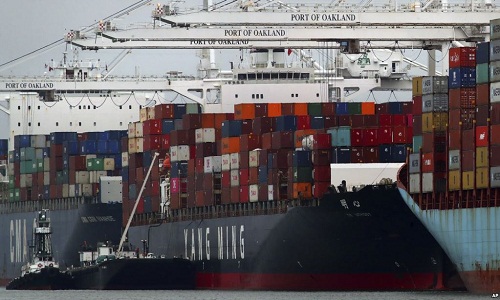 have a negative impact on fashion brands/retailers and customers as prices will rise across the board. The company believes there is a time lag before companies increase prices and it impacts customers. Increasing tariff on clothing and footwear would hurt both the economy and brands/retailers.
To deal with this, most companies have developed a contingency plan which includes shipping some products earlier than usual and shifting some production outside China. However, these actions will also have ripple effect on prices which is expected to rise in many countries and very little unused capacity at the most sophisticated production facilities.
According to Hughes, companies can adopt certain strategies in the short-term to minimise the price pressure. However, she warns if the duties increase to 25 per cent, there might be a substantial price increase by mid-2019.
Reshore jobs, bolster production
Auggie Tantillo, President and CEO, National Council of Textile Organizations (NCTO) supports the US president’s decision to address China’s unfair trade practices. However, he believes imposing tariffs on apparel and other textile end items would reshore jobs throughout the domestic supply chain. Further, it would bolster production throughout the western hemisphere where there is ample supply from multiple countries. Shifting sourcing away from China to suppliers in the USMCA/CAFTA region would also alleviate any impact to consumers, since producers in this hemisphere enjoy duty-free access to the United States.
Negative effects of non-China sourcing strategy
Rick Helfenbein, President and CEO, AAFA terms 25 per cent tariff as a non-starter. He believes American business operating on tight margins cannot absorb such an increase leading to a rise in prices for American consumers. He also feels an abrupt shift to a non-China sourcing strategy would have a catastrophic effect on its already fragile sourcing eco-system.
Levi’s denim customisation offers creative freedom to customers
To what consumers’ appetites for perfectly damaged jeans, Levi’s has been selling denim customised by Aldridge, rapper Snoop Dogg, actress Sasha Lane, surfer Kelly Slater, tattoo artist Dr. Woo, basketball star Blake Griffin and others.
Model Lily Aldridge, Vice President of technical innovation for Levi's, designs a pair of jeans on an iPad alongside Bart Sights. So does her husband, Kings of Leon singer Caleb Followill, A pair of Levi's designed by Lily Aldridge go through the laser process.
Technology to create personalized experiences
Levi’s plans to expand its customisation program next year where consumers can follow Aldridge’s lead and get their denims customised. The brand will install a laser machine, developed by Spanish company Jeanologia, in one of its stores in the U.S. Online and in stores, consumers will use a similar app to personalise their jeans. Levi’s is yet to finalise the cost for customisation of their jeans.
Lily Aldridge places a tear on a pair of jeans she personalises at Levi's temporary downtown L.A. studio. She has customised so far two pairs of jeans and drew cheetah spots on a back pocket with the laser machine. These jeans are displayed by Bart Sights, Vice President-Technical Innovation for Levi's.
Besides beating fast fashion at their own game, customisation delivers what people need when they want it, and giving them the freedom to express their creativity.
Uniqlo profits up 38 per cent, continues retail expansion globally
Uniqlo’s operating profits have steadily increased each year, with a reported growth in August this year of 38.1 per cent. The Japanese retailer is attempting to take over the European market. This Fall, it opened stores in Stockholm and Amsterdam and has announced more European stores next year, including Copenhagen and Milan.
Uniqlo wants to be known as an important and influential player in the fashion industry. It wants to be Japan’s answer to Zara or H&M. Meanwhile Uniqlo plans to double the number of stores in Southeast Asia and Oceania to about 400 by 2022. The emphasis is on standalone suburban stores meant to extend the brand's reach beyond shopping malls. Standalone suburban locations were key to the chain’s growth in Japan.
The Japanese retailer aims to triple revenue generated in the region in the year ending August 2022. That would mark a faster rate of growth than for Uniqlo overall, which expects revenue to double over the same period.
Besides Thailand, Uniqlo’s presence in the Asean region covers Australia, Indonesia, Malaysia, Singapore and the Philippines. For Uniqlo, the Indian market has the potential to become the next China -- Uniqlo's biggest market outside of Japan.
UK apparel retailers under pressure to comply
There are concerns over the sustainability of the UK fashion industry and the vast amount of associated waste that is channeled to landfills. In the UK, some 235 million items of clothing are sent to landfills a year and 1.3 billion tons of carbon emissions are produced by the global fashion industry.
As consumer awareness increases, this year has seen an unprecedented war on single-use plastic with most companies ditching plastic straws and plans announced by many to reduce waste, the fashion industry might have to change its tune of denial. Rock-bottom prices by UK fast fashion retailers are leading to a throwaway culture.
Fast fashion retailer Primark is planning to launch a take-back scheme next year, where clothes can be returned once they are no longer wanted and used by overseas charities. While this scheme is a step in the right direction, it is not enough and presents the industry with the problem of what to do with all the garments returned as the UK lacks an industry that deals with these materials. With UK high-street already struggling, retailers may have to consider being drivers of change rather than risk being branded as unethical by consumers down the line.
Pakistan: PCGA opposes import of raw cotton
Pakistan Cotton Ginners Association (PCGA) has opposed the import of raw cotton through Torkham and Wagah borders, terming it against the law and detrimental to local cotton growers as well as the national interests. They argue granting permission to cotton import through Torkham or Wagah border was unlawful as cotton can only be imported through the seaport. They suggested the government to impose regulatory duty and sales tax on the imported cotton to save the local market.
They feared granting import permission would not only depress the local cotton prices to the disadvantage of growers but may also hurt the indigenous crop because the country had no fumigation facilities at the borders to make the import pest free.
Quoting import law, the PCGA office-bearers said the import was also illegal for raw cotton as it could only be imported with prior permission of the DPP and adopting phytosanitary measures complying with the Plant Protection Quarantine Act 1967, which also disallows cotton import other than Karachi seaport, where quarantine and fumigation facilities are available. Around 1,947,544 bales were lying unsold in ginneries and another two million bales would be received from the field in near future. In the presence of four million bales in the country, it is an unwise decision to allow the import of cotton from neighboring countries.
Textiles sector a success story India
The textile industry is the second largest industry in India. India is the largest jute producer in the world and the second producer of cotton and silk worldwide. The evolution of the textile industry has been phenomenal. From being a country that produced to take care of domestic requirements, the sector has grown manifold to become the second largest producer in the world.
Textile structures in technical applications are creating new market potential. The growth and success of Indian textile industries lie in the vertical integration of policies and framework which have helped manufacturers in domestically subjugating the entire process which also bears an impact on the overall cost like raw material treatment, captive power generation etc. This has also led to in-house production of cotton, jute etc.
Natural fibers like cotton, wool, which are currently exempt from tax, are taxed under GST. For example, it is levied at five per cent for cotton and 18 per cent for synthetics, while silk and jute are exempt. Despite this, the textile industry as a whole would benefit from GST. With the advent of GST, various fringe taxes like octroi, entry tax, luxury tax etc, are subsumed. This helps reduce costs for manufacturers.
Istanbul Yarn Fair in February
Istanbul will host its version of the yarn fair from February 28 to March 2, 2019. This event will showcases products like knitted fabrics, cotton yarns, cotton blended yarns etc. in the textile, fabrics and yarns industry. Leading yarn manufacturers from Turkey and other countries will display their innovative and advanced technology products. The trade fair will see 308 companies and company representatives from 15 countries.
The fair hosted 12,498 visitors from 84 different countries in 2018. In the first half of the year, Turkey’s exports increased 7.3 per cent compared to the previous year. The textile and raw materials industry is getting ready to break its record in the history of Turkey given the export rates.
Woven and knitted fabric manufacturing suppliers aimed at meeting the requirements of the market and competing in both domestic and foreign markets, have embarked on a quest for product range in yarn. In this context, fairs meet the needs of woven and knitted fabric manufacturing suppliers so that they can access yarn resources and fulfill renewed and increasing demands quickly.
With robotic technologies being utilised more and more in ready-to-wear clothing worldwide, home textile and ready-to-wear clothing being diversified each year, and the continued search for design and distinctiveness in ready-to-wear clothing, the yarn used in woven and knitted fabric manufacturing has gradually become very important.
VITAS, WWF launch water risk report for textile and garment industry
The Vietnam Textile and Apparel Association (VITAS) and the World Wildlife Fund (WWF) launched a water risk report for Vietnam’s textile and garment industry and a tool for assessing water risks in the Mekong region in Ho Chi Minh City. The report “Textile and Garment Sector in Vietnam: Water Risks and Solutions” features 12 recommendations of the WWF to boost links among relevant agencies of the sector while promoting the management and improvement of water resources and sustainable energy use.
According to VITAS, Vietnam ranks fourth among textile exporting countries in the world, after China, India and Bangladesh. In the first half of 2018, total export turnover of Vietnam’s textile and garment industry reached $16.5 billion, up 17 per cent over the same period last year. Foreign direct investment (FDI) into the sector hit U$2.8 billion, lifting the accumulated FDI in the industry to $17.5 billion, with the Republic of Korea; Japan, and China being the biggest investors.
According to Van Ngoc Thinh, Country Director of WWF, as Vietnam’s textile and garment industry depends significantly on water and energy for production, it needs the initiatives to promote its sustainable development, thus contributing to the national economy and ensuring goals on environment.
India leads market for adaptive clothing
The global adaptive clothing market is expected to grow at a CAGR of 4.1 per cent over 2018 to 2026. Demand for adaptive clothing from an aging population and rising disabilities in adults and children worldwide is fuelling growth in this sector.
The increasing percentage of people with disabilities in the US is expected to propel growth of the adaptive clothing market. The percentage of people with disabilities in the US increased to 12.8 per cent in 2016 from 11.9 per cent in 2010.
Asia Pacific is expected to witness high growth, owing to the significant amount of population with various disabilities, particularly in economies such as India. Around 2.21 per cent of the population in India has some type of disability. Although the low presence of adaptive clothing retailers in the country is hindering market growth, it is also providing growth opportunities for new companies to enter the adaptive clothing market.
Demand for stylish adaptive clothing is rising as such clothing, apart from providing solutions to disabled people, also provides a stylish look. Brands such as Runway of Dreams and Tommy Hilfiger are offering a wide range of stylish adaptive clothes for disabled children and adults.
China to overtake US in world fashion market in 2019
According to the Third annual State of Fashion Report, co-published by McKinsey & Company and Business of Fashion, US will cede its position as the world’s largest fashion market to China in 2019. The McKinsey Global Fashion Index forecasts growth of 3.5 to 4.5 percent next year, which will come in slightly below the predicted 4 percent to 5 percent growth for 2018.
The report emphasises in the coming year, companies need to take an active stance on social issues, satisfy consumer demands for ultra-transparency and sustainability, and, most importantly, have the courage to ‘self-disrupt’ their own identity and the sources of their old success in order to realise these changes and win new generations of customers. They also need to invest in enhancing their productivity and resilience, as the outlook is increasingly uncertain. External shocks to the system continue to lurk around the corner, and growth cannot be taken for granted.