FW
China to be top fashion market by 2019
By 2019 China will overtake the US as the world’s largest fashion market. Many luxury labels already depend heavily on Chinese customers, who have for some time been the world’s biggest buyers of luxury goods. The wealth of China’s nearly 1.4 billion people is rapidly multiplying, creating legions of new consumers with disposable income to spend on things such as sports, entertainment, and of course, clothes and shoes.
It’s shaping the way the fashion industry operates. Italian label Ermenegildo Zegna, for example, now looks to China, not the US, as the place where it tests new products before deciding whether to roll them out around the world. Sports brands such as Nike and Adidas are investing heavily in their Chinese businesses, as the growing middle class has more leisure time and money to devote to exercise and fitness.
Under a moderate scenario of growth, China is expected to add a number of consumers and spending power roughly equivalent to Germany’s current economy by 2025. China is poised to reach a milestone that signals how the rebalancing of economic power in the world is reshaping industries with it. There is an ascendance of young shoppers and policies are encouraging shopping.
Lectra’s ‘Fashion On Demand’ is first of its kind personalization process
Lectra’s Fashion On Demand is fashion’s first end-to-end personalization solution. This is a breakthrough solution enables fashion companies to personalize at ready-to-wear production speed. It automates the entire personalization process from product development to the final cutting stages.
Fashion On Demand is available in the form of two packages, one dedicated to made to measure, and the other to customization. This turnkey solution automates on-demand production right from order reception to production development stages and the cutting room. Companies can define the product customization criteria and range for each item depending on the package (such as altering product characteristics for customization and pattern adjustments for made to measure) and launch production processes right from the get-go, without interfering with their standard workflows.
The digital revolution has prompted consumers to demand personalized products and experiences. This is an advantageous business model for fashion companies as it allows them to accurately match supply with demand and solve a host of problems that regular business models usually face. By simply knowing ahead of time what and how much their consumers want, companies can produce in precise quantities and avoid overstocking and markdowns. In addition, as consumers pay upfront for their orders it improves cash flow for businesses. Fashion companies can use personalization as a way to outshine their competitors and earn consumer loyalty, by offering one-of-a-kind products that make their customers feel exclusive.
Chanel to ban use of exotic animal skin
Chanel has banned the use of exotic animal pelts in its collections. The brand removed Python skin bags from its website recently although secondhand bags were still on sale from online resale sites. Its handbags made from them reportedly sell for up to $10,300. Animal rights groups welcomed the move, with People for the Ethical Treatment of Animals (PETA) hailing Chanel as giving a lead to other luxury brands.
Although top fashion brands have been under heavy pressure to renounce fur, with Gucci, Armani, Versace and John Galliano all deciding to go fur free, Chanel's decision to stop using exotic skins came as a big surprise. Animal rights campaigns against the use of crocodile and snake skin products have not got the same traction with the public as similar crusades against fur, with some luxury brands even investing in reptile farms so they can guarantee that skins are sourced ethically.
Bangladesh opens apparel units in rural areas
Apparel exporters in Bangladesh are opening factories in rural areas. The apparel sector in the country is gradually spreading to rural regions from a handful of industrial belts in urban areas. Triple Seven Apparels has a factory on 21 bighas of land in a remote place. The 2,40,000 sq ft floor of the factory is centrally airconditioned. The production line opened in December 2016 with four swing lines, which has now extended to 16 swing lines. The plan is to add ten more swing lines next year. About 1,500 people are currently working in the factory. The capacity is around four lakh units of woven products a month.
Approximately 150 export-oriented apparel factories have already been established in rural areas. Labor is easily available and employment gets generated. So the rural economy gets a boost. Factories in rural areas help garment workers live in close proximity to their own village areas, where the living cost is much lower than in the city. In addition they get training and experience in garmenting.
A factory established in a rural area adds value to other economic activities like small businesses, house rent services, bank and insurance facilities and hospital facilities.
Taipei IN Style 2018 explores sustainable fashion and functional innovation
Taipei IN Style (TIS), held from November 8 to 11, 2018, emphasised the ‘Sustainable Fashion and Functional Innovation’ in Taiwan’s high quality textile and apparel industry. This was illustrated by four themes: ‘Sustainable Fashion and Functional Innovation- the Power of Taiwanese Brands,’ ‘International Exposure Projects – Presenting Asia’s Fashion Talents’, ‘Expanding Fashion Industry with Smart Tech’ and ‘Asia’s Fashion Apparels Brands gathered at Taipei IN Style.’
Taipei IN Style 2018 featured over 120 apparel brands from Japan, Hong Kong, China, Taiwan, etc. It hosted a total of 13 house shows and an international competition, 5 seminars about fashion trends and international market potentials, as well as one brand event, attracting buyers from Europe, Japan, China, Southeast Asia and around the world.
The fair gathered top designer brands and fashion institutes from around the world, including Gioia Pan who won the 18th Golden Top Award in China, Yenline Hsu known for her exquisite techniques, ‘Madammay’ and ‘Hong Chubby' designed by May Hsu, which focus on detail cuttings and achieve fashion and high quality at the same time.
Shima Seiki’s Ikuto Umeda on being a technology leader and the digitalisation of China’s knitwear manufacturing industry
 As a knitwear exporting country, China is still a giant, but is smaller than it once was, with some production recently moving to countries like Vietnam and Bangladesh and even parts of Africa. China, with its huge population of 1.37 billion, had been the epicentre of the world’s knitwear exporting industry for decades with its enormous labour pool and low labour costs, but now rising labour costs and labour shortages have, and are still changing significantly.
The situation in China’s domestic manufacturing industry is quite different, however. With consumers wielding real spending power with domestic fashion brands, China has to find ways to satisfy demand. At last month’s ITMA Asia + CITME in Shanghai, Knitting Industry spoke to Mr Ikuto Umeda, Director of Sales Headquarters at Shima Seiki Mfg. Ltd., the man responsible for, amongst other things, sales of Shima Seiki machines in China.
Adopting Industry 4.0
“With rising living standards and booming demand, China’s domestic needs in terms of knitwear and other apparel cannot be met conventionally. Production needs to change, and China has to deal with it. China has to adopt Industry 4.0,” Mr Umeda opened.
Digitalisation and automation were accordingly the key message at ITMA Asia + CITME, which hosted over 1600 exhibitors and attracted around 100,000 visitors, many of whom flocked to see Shima’s Total Fashion System.
Digitalisation
The Japanese company’s solution is a complete digital system which aims to maximise profits while achieving zero inventory loss, zero leftover stock, zero lost sales opportunity and most importantly zero waste through smart, speedy and sustainable production.
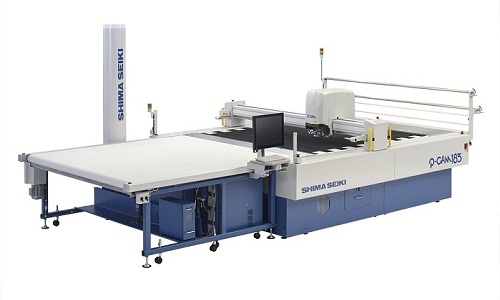
The concept started off as the Total Knitting System in the 1980s and was then extended into other areas of fashion and textiles via the company’s P-CAM cutting and SIP printing technologies, emerging as the fully-fledged Total Fashion System only in recent years.
Automation
The automation part of the Total Fashion System comes in the shape of the company’s WHOLEGARMENT knitting technology, a pioneering seam free knitting solution, which is now gaining real traction in the Chinese domestic market. Ikuto Umeda explains:
“Our solution for automation is of course our WHOLEGARMENT knitting technology, which many people in our industry already know well. Garment make-up, including neck linking is difficult in China as labour costs have risen and there is now a shortage of labour. This has increased the need for automation and therefore we have been selling our flagship MACH2XS and MACH2S WHOLEGARMENT machines in significant numbers over the past three years in China.”
Sustainability
According to Mr Umeda, Shima’s Total Fashion System is the only complete sustainable digitalisation solution that can meet China’s needs. “For exports, China has now reduced its capacity with the China +1 countries plus Bangladesh growing as knitwear suppliers. But domestic demand in China is huge – with the country’s rising standard of living and the aspirations of the young generation demand is so high that it cannot be met conventionally.”
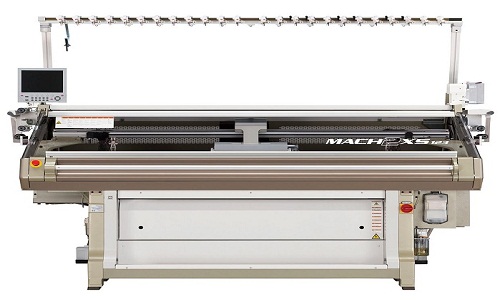
“As I said earlier, production needs to change. China has its own fast fashion brands which are booming, and to satisfy them, the industry has to adopt Industry 4.0. Our zero-waste solution offers significant cost reduction and IT based production management systems like our Shima KnitPLM are essential for manufacturing efficiency.”
Mr Umeda believes that, even if large scale production returns to traditional manufacturing centres like Europe and the USA, it will have to be automated and digitalised.
“Reducing yarn waste in knitwear production is one of the advantages of WHOLEGARMENT knitting but zero or low waste is not the only solution. What about the waste that is created when garments do not sell?”
“Highly realistic simulation capability on APEX3 allows virtual sampling which minimises the impact the sample-making process has on manufacturing, both in terms of time and cost. With our new manufacturing model, the production cycle can be shortened to such an extent that on-demand production is possible without being limited to seasonal cycles. This allows the product planning stage to be extended to allow more accurate analysis of consumer demand and this drastically reduces waste because the manufacturer doesn’t make what the market doesn’t want.”
Importance of patents
As a technology leader, Mr Umeda stresses the importance of patents for Shima Seiki and more importantly the company’s commitment and right to enforce its patents to protect its cutting-edge knitting technologies from some unscrupulous copycat manufacturers in Asia. The company owns around 5000 patents worldwide, around 2000 of which cover its WHOLEGARMENT technology.
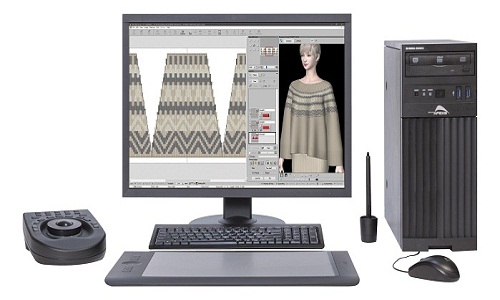
Shima’s patent portfolio covers not only knitting machines but also knitting techniques and systems. For example, in conventional WHOLEGARMENT knitting, where the garment is knitted by combining three tubes side by side (sleeve, body, sleeve), Shima has many patents covering shoulder bind-off, neck bind-off and neckline knitting techniques for a variety of neckline styles.
Also protected by worldwide patents are multiple pocket style techniques, gusseting techniques for underarm engineering for fit, as well as numerous set-up techniques for commencing knitting.
Shima also has global patents covering unconventional WHOLEGARMENT knitting. For example, the method of knitting a garment on its side from cuff to cuff is also covered by multiple patents. These include patents covering cuff bind-off, cuff set-up, side bind-off and side set-up techniques.
On patents, Mr Umeda is very clear and very firm. “We will and do enforce our patents. We must protect the technologies we have spent many decades developing and most importantly we must protect our customers who use our WHOLEGARMENT technology.”
Knitifying the World
Ikuto Umeda goes on to talk about Shima Seiki’s technical textiles business – the company has sold a lot of machines into the shoe-upper sector and other non-fashion segments in recent years, not just WHOLEGARMENT technology but also technologies such as the company’s SVR hybrid inlay technology.
He talks about ‘Knitifying the World’, where products made using traditional manufacturing methods will in future be made using 3D knitting using the company’s flat knitting technology. There are many examples of Knitifying on display at the Shima booth ranging from luggage and handbags to suspension fabrics for chairs to wearable computing and heated garments.
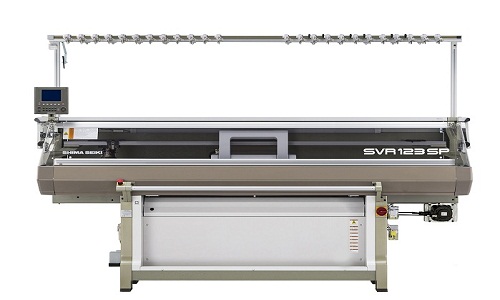
“We are planning to expand our ‘non-fashion’ division to realise our goal of Knitifying the World with our technology,” Mr Umeda states. On the question of what will be the next ‘killer application’ in technical textiles, he comments: “Wearable technology will be an important area of application, especially when applied to the automotive industry. Of course, composites are also possible, especially using our hybrid inlay knitting technology using special yarns such as carbon fibres.”
Made in Japan
Our final question for Ikuto Umeda relates to manufacturing machines in China – all of Shima’s competitors do it to a greater or lesser extent, but not the Japanese company. Mr Umeda concludes: “There are of course tariff issues between Japan and China which would make manufacturing there difficult, but the real issue is that we make cutting edge technology and while we make cutting edge technology it will and must continue to be Made in Japan.”
FESPA Eurasia 2018 to kick off on 6th December 2018
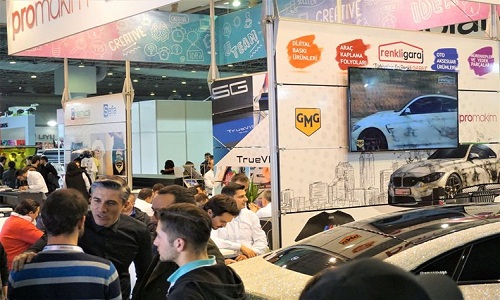
FESPA Eurasia 2018 will take place next week from 6th – 9th December in Istanbul Turkey at a new venue, Istanbul Expo Centre. The exhibition centre is located near the city centre and the exhibition will occupy two halls, Hall 9 and Hall 10.
FESPA Eurasia 2018 is the region’s leading event for screen, textile and digital wide format printing. The exhibition will be hosted in partnership with FESPA’s Turkish Association, ARED which will reflect the needs and challenges of the regional Eurasia market.
Attending the exhibition will provide visitors the opportunity to meet and network with leading and local manufacturers and access to free educational features including Print Make Wear, FESPA World Wrap Masters Eurasia 2018 and signage demo workshop.
Print Make Wear will feature live demonstrations of the latest in both fast fashion production and garment decoration. Visitors will experience the complete garment production process from design all the way through to the finished garments and will be able meet with experts. The show feature will highlight both screen and digital print technologies including the latest design and workflow software, direct to textile printing and a live screen printing automatic and manual production showing the latest special effects.
The World Wrap Masters Eurasia 2018 will provide regional wrap installers the chance to showcase their expertise and creativity to the global wrap commuting whilst competing to be crowned the winner. The competition will be sponsored by Hexis Graphics, Mimaki Eurasia and Car Wrapper 3D. Judges for the competition are Carlos Ruiz from Spain and Kiss Laoi, two-time world champion from Hungary. The crowned winner will win a trip to the Global Print Expo 2019 in Munich from 14th – 17th May 2019 where they will compete against other regional winners for title of World Wrap Master.
The signage demos will showcase the latest in traditional modern sign making techniques including sign writing techniques, neon and LED signage production and the demos will take place every day of the exhibition.
For more information on FESPA Eurasia 2018, its features and to pre-register to attend, visit www.fespaeurasia.com and use code EURJ803 for free entry.
ColorJet displaying its best selling digital textile printer VASTRAJET at DTG-2019
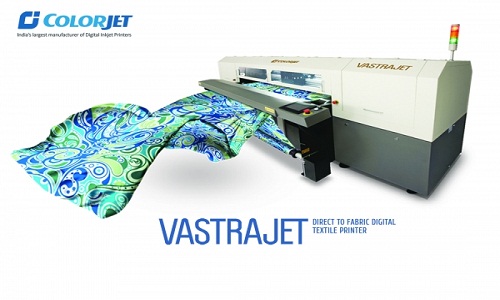
ColorJet participating at DTG for first time with best selling digital textile printer
VASTRAJET best suited for printing home textiles due to 320 cms width
ColorJet all set to repeat its Indian success story in Bangladesh
ColorJet India Ltd, India’s largest manufacturer and exporter of digital textile printing technologies will be launching and showcasing live demonstrations of its best selling direct to fabric printer, VASTRAJET at DTG-Dhaka which runs from January 9-12, 2019, at ICCB in Bangladesh in hall no. 6, booth no. 313.
ColorJet digital printers are an established name in, both textiles, as well as sign & signage applications. ColorJet digital printers are reputed to offer reliable performance year after year. Having firmly established itself as the biggest digital printer manufacturer in India, ColorJet is now all set to repeat its success story in Bangladesh and countries of Asia, Africa and Europe.
The consumers of Bangladesh share a common passion for colourful textiles with consumers of India and ColorJet brings to the table its experience and expertise, which includes a deep understanding of fashion sense in the sub-continent.
Fully realising that investment in digital printing requires a lot of support and hand holding in the initial stages, ColorJet has tied up with Universal Textile Machinery & Spares Ltd - Bangladesh to fully meet the need for making spares and consumables available to customers in Bangladesh.
To investors in digital printing, perhaps even more important than the technical support, it is the extensive and the holistic approach to selling a digital inkjet printing solution rather than a digital inkjet printing machine.
The VASTRJET is a workhorse with its robust Konica-Minolta print heads and for the production rate it delivers, it probably has the lowest carbon footprint. The printer is ideally suitable for home furnishing producers with a working width of up to 320 cms.
What’s more, it is also available in a hybrid version or two ink systems. Though reactive dye inks are the most popular choice in the sub-continent, pigment inks are preferred by some. ColorJet offers the VASTRAJET in the open system with both ink systems and also with direct disperse.
“Before the end of 2019, ColorJet hopes to install atleast five printers in Bangladesh, two of which are already in advanced stages of negotiations,” Jitender Pal Singh, Textile Head at ColorJet India said.
ColorJet maintains its No.1 position in India as per the latest IDC 2018 Q1 Super Wide Format report, while assiduously pursuing excellence in digital printing since 2004.
About ColorJet India Ltd:
ColorJet India Ltd, the largest manufacturer of digital inkjet printers in India, markets its products in 14 countries worldwide. Founded in 2004, the company maintains its operations via two manufacturing facilities and sales offices spread across seven countries, which include India, China, Bangladesh, UAE and Sri Lanka. To-date, ColorJet has installed and implemented over 4,000 of its printing solutions and products across 315 cities around the world backed by a strong 278 member team, of which almost 100 are in technical related
EFI unveils new Reggiani textiles printer
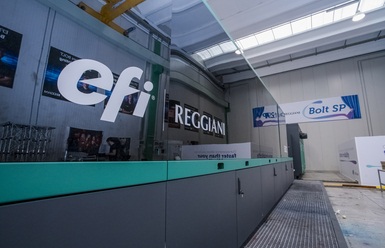 Available to order now, with units shipping in the first part of 2019, the Bolt is a 1.8m-wide machine that prints directly onto textiles at speeds up to 90m/min or 8,000sqm/hr.
It made its debut at an EFI Reggiani open house in Italy last week and, according to the company, it offers high uptime and reliability, outstanding performance, superior printing uniformity and accuracy, long printhead life and minimal maintenance needs.
EFI Reggiani vice-president and general manager Adele Genoni said: “The innovation of our new single-pass digital textile printer stems from a serious commitment of listening to and addressing our customers’ needs. Before kicking off this project, we completed interviews with customers across the world back in March and April 2017.
“The need for performance, uptime and productivity, printhead reliability, and printing quality were the key takeaways from these interviews. The Bolt is for customers who need high productivity with a short delivery or turnaround time, targeting textile manufacturers, but also apparel businesses.
“We have had a great level of interest for the printer and have already received several quotations. New and existing customers at the open house were extremely impressed with the printer’s speed, accuracy and output quality. There was a uniform sound of excitement and enjoyment when the printer was in action.”
Running with the EFI Fiery digital front-end, the Bolt’s headline features include a contactless wiping system to enhance the life of its printheads, which were developed specifically for the machine and print at 600dpi resolution. A premium setting increases resolution up to 600x4,800dpi.
It is intended to compete with a number of textile printers already on the market, including the MS LaRio, the Konica Minolta Nassenger and the SPG Pike.
According to Genoni, the initial Bolt machine is the first entry in an intended product line-up that will come with future developments and variations. She alluded to paper transfer and a wider 3.4m configuration as “on our product development roadmap”.
Epson to display home textile machinery at Heimtextil expo
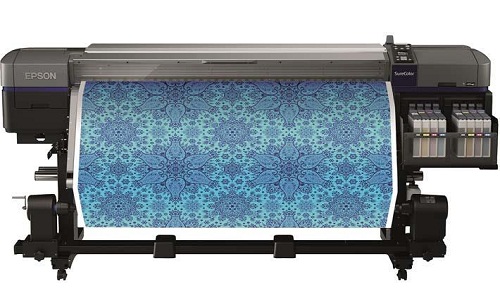
Epson will show its offer for the home textile market for the operators in the sector and visitors, at Heimtextil expo, in stand G81, hall 3. The show for home and contract textiles will be held from February 8-11, 2019, in Frankfurt, Germany. Epson is a leader in connecting people and information with its original, efficient, and compact technologies.
The company will be creating a living room in partnership with Brochier, the prestigious brand of top of the range furnishing fabrics. Some furnishing items will be displayed in this setting. Sofa, armchairs, poufs, curtains, and carpets have been made of fabrics printed by Monna Lisa, featuring the suggestive motif of the Utopian Philodendron, chosen from the company’s archive of furnishing fabrics. Demos will be provided by the printer SureColor SC-S80600, ideal, for instance, to print wallpaper, and by the printer SureColor SC-F9300 for sublimation textile printing, the ideal solution to personalise household items and to create 3D printed objects, such as plates, cutlery, and vases, Epson said.
The SureColor SC-F9300, 64” is a user-friendly economic printer. This highly flexible machine is the ideal choice to produce small volumes of quality fabrics and to sublime custom-designed motifs on hard substrates, such as, for example, anti-splash panels, table tops, cups, cutlery and vases. A 4-colour printer that uses UltraChrome DS ink with high density HDK black, the model SC-F9300 offers Epson PrecisionCore TFP double print heads for consistent and reliable results that feature exceptional colours and definition.
The SureColor SC-S80600 printer supports a wide range of substrates to meet all needs, from posters to graphic applications and interior decoration. With its advanced substrate management system, the printer ensures high precision for exceptional performance. Automated maintenance of print heads and the collection system for condensate produced by ink allow uninterrupted printing, thus ensuring high levels of productivity.
The SureColor SC-F2100 for direct printing on fabric can produce, in a few minutes, kitchen towels, aprons, cushions, and personalised bags. A printer that is highly appreciated by the market: Epson estimates that, from its launch until August this year, it has been used to print about 36 million t-shirts worldwide. (GK)