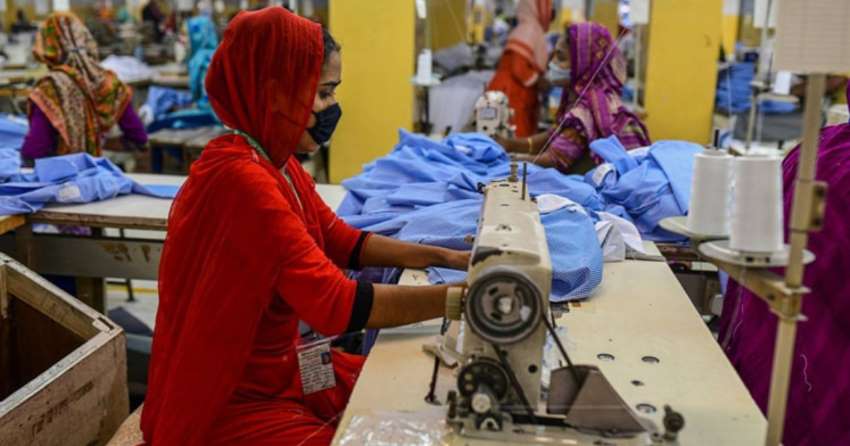
Pakistan is framing a long term and comprehensive textile policy. The aim is to increase Pakistan’s share in world garment exports. Its small and medium sector will be promoted and developed. A task force will focus on facilities and incentives to attract investors to this sector. The task force will also work on the development of genetically-modified cotton seeds and ensure consistency in business policies. The industry wants levies on cotton imports removed so that textile exports can go up. The country’s textile exports constitute more than 60 per cent of total exports. Knitwear exports comprise 14.4 per cent of total exports. Readymade garment exports have a share of 12.5 per cent in exports. Bedwear has a 10.7 per cent share in exports. A special energy package was extended early this year to the erstwhile zero-rated industry to provide it a competitive energy tariff to expand and increase exports.
Pakistan’s textile industry has become viable after a gap of 10 years, especially through the provision of regionally competitive energy tariffs. The industry witnessed a record 26 per cent growth in quantitative terms.
Previous textile policies have not been much of a success story. The policy for 2014-19 failed to achieve its targets including doubling value addition, increasing textile exports as well as the creation of three million jobs in five years.

- 1
- 2
- 3
- 4
- 5
- 6
- 7
- 8
- 9
- 10
China’s inward turn, domestic demand is rewriting the export model
China is undergoing one of its most consequential economic recalibrations in decades, driven by geopolitical instability, rising Western protectionism, and... Read more
Egypt bets on a $2 bn green textile city to become Europe’s next sourcing hub
Egypt is making a decisive play to become one of the world's most important apparel manufacturing destinations after securing a... Read more
EU textile imports hit $295.66 bn as price wars mask manufacturing stress
The European Union’s textile and apparel imports grew to $295.66 billion in 2025, a 9.4 per cent year-on-year increase from... Read more
Landmark India-UK trade pact to supercharge textile export margins
The long-awaited India-UK Comprehensive Economic and Trade Agreement (CETA) is officially scheduled to commence on July 15, 2026. This breakthrough... Read more
Is it the end of aspirational luxury? Asia’s consumers demand more than logos
While the global personal luxury goods market remains broadly stable at around €358 billion, the apparent resilience masks a deeper... Read more
Vietnam wins, India slips as US apparel sourcing undergoes massive reset
A trade realignment is transforming the global apparel market, yet India’s manufacturing has stalled at the starting line. Newly released... Read more
US clothing prices rise faster than inflation, reshaping fashion retail strategy
After nearly two years of heavy discounting, inventory liquidation, and margin decline, apparel prices in the US are now rising... Read more
From gym to boardroom performance fabrics are redefining apparel demand
The global apparel industry has entered a new phase of evolution as the distinction between sportswear and everyday fashion continues... Read more
Digital Dominance Redefined: Zara moves past H&M in $100 bn fast fashion bat…
The global fast-fashion sector has reached a inflection point in 2026 where the battleground is no longer only store shelves... Read more
Spykar accelerates offline expansion: plans 100 new stores across India
A titan of the Indian denim-first fashion scene, Spykar has officially unveiled an aggressive retail growth strategy. As consumer demand... Read more