FW
Lectra launches new digital platform to revolutionise apparel production
Launched with an aim to revolutionise the apparel industry, Lectra’snew digital platform, Valia Fashiondrives sustainability and modern processes by connecting all production stages.
Unveiled at Lectra's headquarters in Cestas, the platform is designed to accelerate the transition to Industry 4.0, enabling brands and manufacturers to enter into a new technological era. Describing the platform as a pivotal market launch, Daniel Harari, CEO, Lectra, says, it will fundamentally change the sector.
The platform optimises material usage by connecting, automating, and streamlining apparel production, from order processing to fabric cutting. This enables brands, manufacturers, and subcontractors to adapt quickly to different types of production, whether small, medium, large series, or on-demand.
Besides, Valia Fashion also helps enhance collaboration across the value chain. Powered by the cloud, artificial intelligence (AI), and an industry-specific data model, the platform digitalises the entire production flow, allowing seamless interaction between brands and subcontractors, irrespective of geographical constraints. By connecting all processes, the platform reduces manual work, optimises resource allocation, and improves efficiency.
The platform also provides a greater visibility into the current and future operations, with precise estimation and traceability of materials used. Valia Fashion automatically analyses and optimises the performance of the cutting room, centralising and securing all data for better decision-making. It also measures the environmental impact of production by estimating material consumption based on real constraints.
Representing a major technological leap, Valia Fashion drives the fashion industry into a new era of Industry 4.0. It offers a completely new way to address the challenges of modern apparel production, says MaximilienAbadie, Chief Strategy Officer and Chief Product Officer, Lectra.
Denim and casual industry presentation by The Lycra Company offers in-depth market analysis
A denim and casual woven industry trends presentation hosted by the Lycra Company at the Home House in London on Sep 26, 2024 provided an-depth analysis of the UK denim and chino market.
Held in collaboration with Kantar, the event focused on key statistics and consumer trends. Sam Wright, Consumer Editor, Kantar, explains, over the past decade, shoppers in Great Britain have embraced a more laid-back dressing style, with one-third of their incomes being spent on casualwear. Demand for denims in the country is at a five-year high, driven by a double-digit growth in relaxed fits like baggy and boyfriend styles.However, to attract more shoppers and boost sales, brands need to focus on core essentials that blend comfort and everyday style, he adds.
At the event Ebru Ozaydin, Global Strategic Marketing Director-Denim and Wovens, The Lycra Company, unveiled the Lycra FitSense Denim Technology that gives every pair of jeans a perfect fit, for all body types and shapes.
Ozaydin also highlighted bio-derived Lycra fiber, developed by the company in collaboration with Qore to create a sustainable fiber option made from renewable content.
Salli Deighton, CEO, LaundRe, made a presented on LaundRe, a pioneering circular and reshoring denim hub being launched by the company in London. In his presentation Deighton focused on the ability of LaundRe’s innovative services to empower brands to reshape the future of denim through sustainability and creativity.
Tamil Nadu's textile industry falters despite global shift away from China
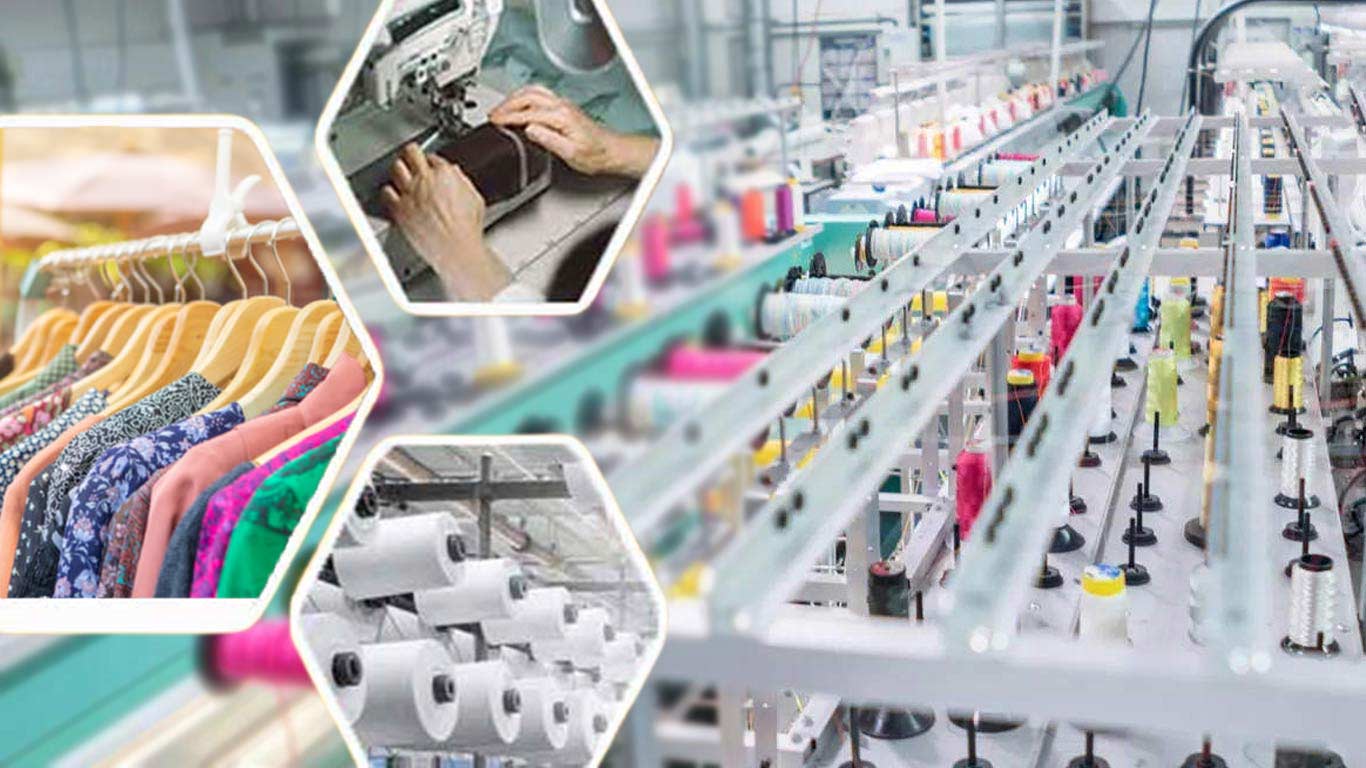
Tamil Nadu's textile sector, a once-thriving industry and significant contributor to the state's economy, is facing a crisis. Ironically, this downturn coincides with a global shift in textile manufacturing away from China, presenting a golden opportunity for states like Tamil Nadu to capitalize. However, internal challenges are preventing the state from seizing this advantage.
What ails the industry?
Labor shortages and automation: The industry is grappling with a severe labor shortage. While automation could be a solution, reports say only 14 per cent of Indian textile companies are ‘winning in the age of automation’. This suggests a lack of technological adoption and investment in modernizing production processes.
High power tariffs: Tamil Nadu has one of the highest power tariffs in the country, making it less competitive compared to other textile hubs. This high cost environment discourages investment and growth.
Low fiscal incentives: The state government's fiscal incentives for the textile industry are less attractive than those offered by competing states. This further hinders investment and expansion in Tamil Nadu.
Competition: The state faces stiff competition from other states within India and countries that are offering more attractive incentives and infrastructure, luring away potential investments and market share.
Low productivity: Tamil Nadu's textile industry ranks low in terms of overall productivity, further eroding its competitiveness.
Table: Comparative costs
|
Metric |
India |
China |
Vietnam |
Bangladesh |
|
Labor Cost |
0.93 |
3.52 |
1.86 |
0.62 |
|
Power Tariff (cents/kWh) |
8 |
7 |
7 |
6 |
|
Fiscal Incentives (Low-High) |
2 |
3 |
4 |
5 |
These challenges have combined to create a situation where Tamil Nadu is securing only 25 per cent of potential export orders, while competing states are capturing the remaining 75 per cent. This disparity is further underscored by the low adoption of technology in the region, with only 30 per cent of textile units embracing automation compared to 70 per cent in other states.
Indeed, the decline of textile sector, a significant contributor to Tamil Nadu's economy, has had several adverse consequences on the state. There is labor shortage and closure of textile units are leading to widespread job losses, particularly affecting rural communities. Also, the textile industry's downturn is negatively impacting the state's overall economic growth and development. And the loss of livelihoods and economic hardship are contributing to social unrest and instability in the affected regions.
To move forward, and revitalize its textile industry, Tamil Nadu needs to take decisive action to address these challenges. It should begin by improving labor attractiveness. Which means it needs to implement policies to improve wages, working conditions, and skill development initiatives to attract and retain workers. The state must encourage the adoption of automation through subsidies, incentives, and awareness campaigns. Infrastructure deficiencies need to be addressed. The state has to invest in upgrading infrastructure, including ensuring reliable power supply and improving logistics.
By taking these steps, Tamil Nadu can regain its position as a leading textile hub and capitalize on the opportunities presented by the global shift in manufacturing.
BRICS+ Fashion Summit concludes with historic Fashion Federation launch
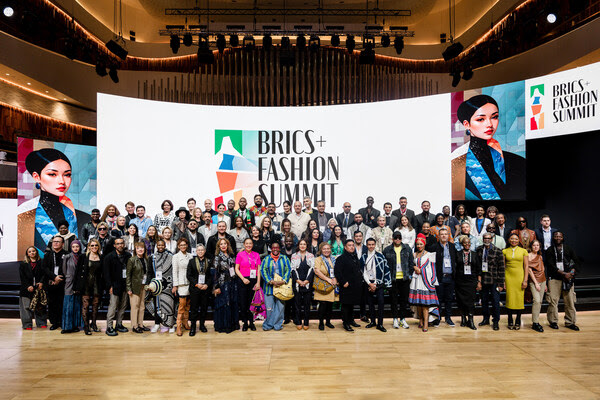
The BRICS+ Fashion Summit in Moscow culminated in a landmark development for the global fashion industry, as representatives from over 50 countries signed a memorandum establishing the BRICS International Fashion Federation. The new federation is set to drive innovation, sustainability, and collaboration across emerging and established fashion markets, reshaping the industry on a global scale.
New powerhouse in global fashion
The BRICS International Fashion Federation aims to create new influence centers within the fashion world. Its mission includes promoting sustainability, fostering innovation, and providing a platform for emerging designers and brands to thrive. By connecting fashion professionals from diverse regions, the federation seeks to offer greater access to global markets, driving growth through cooperation and knowledge sharing.
Key objectives include building a unified platform for emerging markets, supporting local talent, and encouraging cultural exchanges between nations. The federation’s educational initiatives aim to enhance design skills and business acumen among fashion professionals, ensuring a well-rounded approach to industry development.
Jay Ishak, President of the Malaysian Official Designers Association, expressed his support for the federation, emphasizing its potential to strengthen Malaysia’s fashion sector. He highlighted how the country's inclusion could lead to increased trade, enhanced cultural exchange, and expanded market access. Ishak believes the BRICS International Fashion Federation holds the ability to transform the fashion industry by fostering growth, driving innovation, and encouraging cooperation among member nations, positioning it for significant global influence.
A global commitment to sustainability
One of the core missions of the BRICS International Fashion Federation is to promote sustainability within the fashion industry. By advocating for slow fashion and eco-friendly practices, the federation aims to address the environmental impact of fast fashion. The memorandum signed by leaders from various countries reinforces a commitment to reducing the fashion industry’s carbon footprint and promoting ethical production methods.
Deputy Mayor of Moscow, Natalya Sergunina, highlighted the strong backing for the initiative, describing it as a key outcome of the BRICS+ Fashion Summit. She noted the shared goals and significant growth potential the federation represents. Sergunina's comments reflect the optimism surrounding the federation's ability to lead sustainable practices within the fashion industry and drive positive change across the sector.
Looking ahead: A united front in fashion
With its formation, the BRICS International Fashion Federation is poised to become a major player in shaping the future of global fashion. The federation's focus on sustainability, cultural preservation, and innovation aligns with the growing demand for ethical fashion practices worldwide. By bringing together emerging markets, the federation aspires to redefine the fashion industry through collaboration, mutual support, and shared expertise.
As the BRICS International Fashion Federation begins its journey, industry experts and designers alike are optimistic about the opportunities it presents for sustainable growth and cultural exchange. The summit, with attendance from over 100 countries, has cemented its place as a transformative moment in the fashion world, signaling a new era of international cooperation and influence.
Groz-Beckert to showcase innovations at ITMA Asia + CITME 2024
From October 14 to 18, 2024, Groz-Beckert will exhibit at the ITMA Asia + CITME at the National Exhibition and Convention Center in Shanghai, China. The company will highlight innovations across its six product areas: Knitting, Weaving, Nonwovens, Tufting, Sewing, and Spinning, located at Hall H4, Booth C04.
In the Knitting segment, Groz-Beckert will unveil new systems in Circular, Flat, and Warp Knitting. The LCmax circular knitting needle, paired with the SNK-F sinker, features a unique wave-shaped shank that significantly reduces energy consumptionup to 20 per centwhile maintaining machine speed. Additionally, the San Duo system enhances loop structure and minimizes downtime through its low shank design.
The Flat Knitting section will showcase the San TT needle for narrow loops in technical textiles and the San FY for fancy yarns, both aimed at increasing reliability and reducing breakage. The Legwear division will present its durable dur needles designed for sock production, helping to lower costs in knitting processes.
In the Weaving area, the KnotMaster tying machine will be featured, known for its versatility in knotting. Groz-Beckert's high-quality healds and frames are engineered for efficiency, ensuring top fabric quality.
The Nonwovens segment introduces innovations in felting needles, including a new barb design for abrasive fibers and a module developed with the Dilo Group for intensive needling technology. The Tufting section emphasizes precision in its gauge part system, crucial for producing quality floor coverings.
In Sewing, the San series needles are designed for demanding applications, featuring wear-resistant coatings. The company will also highlight its INH quality management system for seamless needle handling and documentation.
Finally, Groz-Beckert's commitment to sustainability will be showcased through various products aimed at reducing its carbon footprint, highlighting its efforts to implement environmentally friendly practices across the textile industry.
Bemberg highlights eco-friendly fashion at Smart Closet event
Bemberg by Asahi Kasei was a key participant in the Zero Edition of the Smart Closet event, held from September 27-29 during Milano Beauty Week. This innovative event, organized by CLASS and Equipe International, promotes a new generation of fashion that emphasizes beauty, innovation, and responsibility.
Bemberg, a regenerated cellulose fiber known as cupro, is produced exclusively by Asahi Kasei in Japan. The fiber's circular economy model is based on a closed-loop process, utilizing regenerated cellulose from cottonseed oil manufacturing. This sustainable approach ensures transparency and traceability, making Bemberg suitable for various applications, from linings to couture.
At the event, Bemberg presented the capsule collection ‘A Dress For Venice,’ designed by eco-designer Tiziano Guardini and illustrated by artist Jacopo Ascari. Produced in collaboration with Martina Vidal Venezia, the collection features elements of Burano lace, an ancient craft nominated for UNESCO Intangible Cultural Heritage status. The garments were crafted from Bemberg fabrics printed with low-water pigment inks by Creazioni Digitali.
A panel discussion titled ‘A Dress For Venice’ featured Guardini, Ascari, and representatives from Creazioni Digitali and Asahi Kasei Fibers Italia. Moderated by CLASS CEO Giusy Bettoni, the talk explored the collection's sustainable journey, demonstrating that fashion can be beautiful, innovative, and eco-friendly. Bemberg aligns with Smart Closet’s vision, promoting a harmonious relationship between aesthetics and responsibility in the fashion industry.
ASBCI to host Conference on AI's impact in fashion and textiles
The Association of Suppliers to the British Clothing Industry (ASBCI) is set to host a conference on October 16, 2024, in Halifax, UK, focusing on the impact of artificial intelligence (AI) on the textile and clothing industries. Textiles Intelligence is the official media partner.
The conference will examine how AI is transforming areas such as trend prediction, product development, stock optimisation, and customer engagement, while also addressing ethical concerns. Key discussions will centre on how AI can drive innovation, reduce waste, enhance efficiency, and present new risks and responsibilities for businesses.
Ahmed Zaidi, CEO and co-founder of Hyran Technologies, will deliver the keynote, exploring the role of AI in solving long-standing industry challenges. His talk will highlight the intersection of fashion and AI, focusing on AI’s potential to meet consumer demands and improve profitability.
The event will also feature notable industry speakers such as Jack Stratten of Insider Trends, Nick Eley from ASOS, and Cedric Hoffman of Ameba. Topics will range from AI’s role in design and supply chains to its potential for waste reduction and personalisation. Additionally, speakers will address legal, ethical, and sustainability concerns tied to AI adoption.
Julie King, chair of the ASBCI, emphasized the importance of understanding AI’s broad impact on the fashion industry and the need for clear direction amid rapid advancements. The conference aims to provide a comprehensive look at how the industry can harness AI responsibly.
Two panel discussions, moderated by Jenny Holloway and Simon Platts, will further explore the benefits and challenges of AI in fashion.
This conference represents a timely opportunity for industry professionals to stay ahead of the AI curve while navigating its complexities.
Bangladesh registers largest decline in apparel exports to the US during Jan-Aug’24: OTEXA
Amongst competing countries, Bangladesh registered the largest decline in apparel exports to the United States during the Jan-Aug’24 period, shows data from the Office of Textiles and Apparel under the US Department of Commerce.
Bangladesh’s apparel exports to the US declined by 9.16 per cent in value and 3.86 per cent in volume during these eight months due to ongoing challenges faced by exporters including rising production costs and extended lead times.
In terms of value, Bangladesh’s apparel exports to the US declined to $4.71 billion during Jan-Aug’24period compared to $5.18 billion in the corresponding period of 2023.
By volume, Bangladesh apparel exports declined to 1.52 billion sqm during Jan-Aug’24 from 1.58 billion sq m exported in the same period of the previous year. Vietnam’s apparel exports to the US declined by 1.06 per cent to $9.56 billion during the first eight months of 2024 from $9.66 billion in the same period of 2023.
China continued to be the largest supplier of apparel to the US market, although the country also witnessed a slight decline during the Jan-Aug’24 period.
Overall apparel imports by the US declined by 2.98 per cent to $10.69 billion during the eight-month period spanning Jan-Aug’24 compared to $11.02 billion in the same period of the previous year. In terms of volume, overall apparel imports by the US increased by 1.41 per cent to $16.71 billion sq m from $16.48 billion sq m in the same period of 2023.
Apparel imports from India and Indonesia also declined during the first eight months of 2024. RMG imports from India declined to $3.21 billion compared to $3.26 billion in the same period of the previous year. Meanwhile, imports from Indonesia contracted by 7.16 per cent to $2.68 billion compared with those of $2.89 billion in the same period of 2023.
On the other hand, apparel imports from Cambodia rose to $2.29 billion from $2.21 billion during the first eight months of 2024 while imports from Pakistan increased to $1.39 billion in the Jan-Aug’24 compared to $1.37 billion in the same period of 2023.
Sector to grow to $350 billion of 2030: Textile Ministry
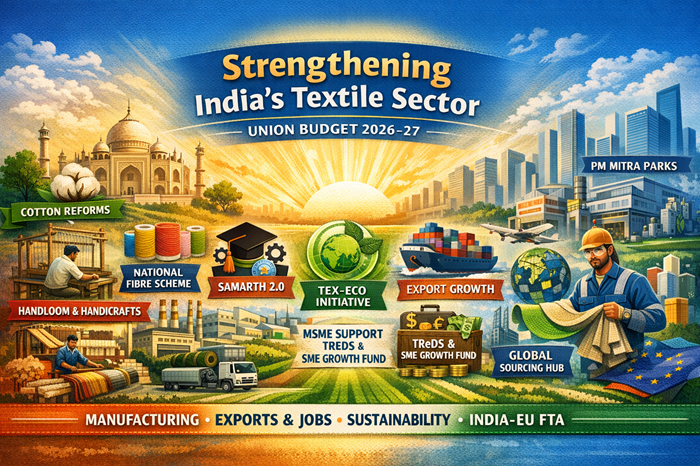
Driven by India’s inherent strengths and a strong policy framework encouraging investment and exports, the textile sector in India is likely to grow to $350 billion by 2030. Trade data of Aug’24 from the Ministry of Textiles shows, India’s RMG exports will grow by 11 per cent Y-o-Y during this period.
With end-to-end value chain capability, a strong raw material base, a large export footprint and a vibrant and rapidly expanding domestic market, India is a traditional leader in the textiles sector.
The Indian government has also launched a number of schemes and policy initiatives to leverage and catalyseits inherent strengths to help the textile sector achieve the targeted $350 billion goal by 2030. The government aims to attract Rs 90,000 crore of investment through PM Mega Integrated Textile Region and Apparel (PM MITRA) Park and Production Linked Incentive (PLI) Schemes in the next 3-5 years. It also aims to focus on schemes like the National Technical Textiles Mission to help India acquire leadership position in emerging sectors such as technical textiles.
Victoria’s Secret to organise fashion show after a gap of five years
After a gap of five years, lingerie brand Victoria's Secret will once again organise its annual fashion show on Oct 15 in New York. The show will feature the brand’s historic models including Tyra Banks, Gigi Hadid and Taylor Hill.
Victoria’s Secret had canceled its annual fashion in 2019, after various controversies, especially regarding the physicality cult of its models, erupted.In response, the company rebranded itself to embrace diversity, body positivity, and inclusivity. This shift included introducing a broader range of models of different sizes, ages, and backgrounds, and launching campaigns that focus on empowerment and authenticity.
In 2021, Victoria’s Secret introduced the VS Collective, a new group of brand ambassadors, which includes women like Priyanka Chopra Jonas, Megan Rapinoe, and Paloma Elsesser. These ambassadors are meant to represent a more inclusive and diverse vision for the brand, focusing on real stories and achievements rather than just physical appearance
A globally recognised American lingerie, clothing, and beauty retailer, Victoria’s Secret is known for its fashion-forward designs and iconic marketing campaigns. Established in 1977 by Roy Raymond in San Francisco, the brand quickly became a leader in the lingerie industry, offering a wide range of intimate apparel, sleepwear, activewear, and beauty products.